Kickoff Read: Why You Lose Possession After First Contact
A fast first touch does not guarantee kickoff possession. Read who is contesting, where the second cars are going, and where the ball exits before you commit.
Your teammate reaches the center ball first. The ball spills sideways. An opponent takes the next touch, and suddenly your team is defending. Winning the race did not win possession.
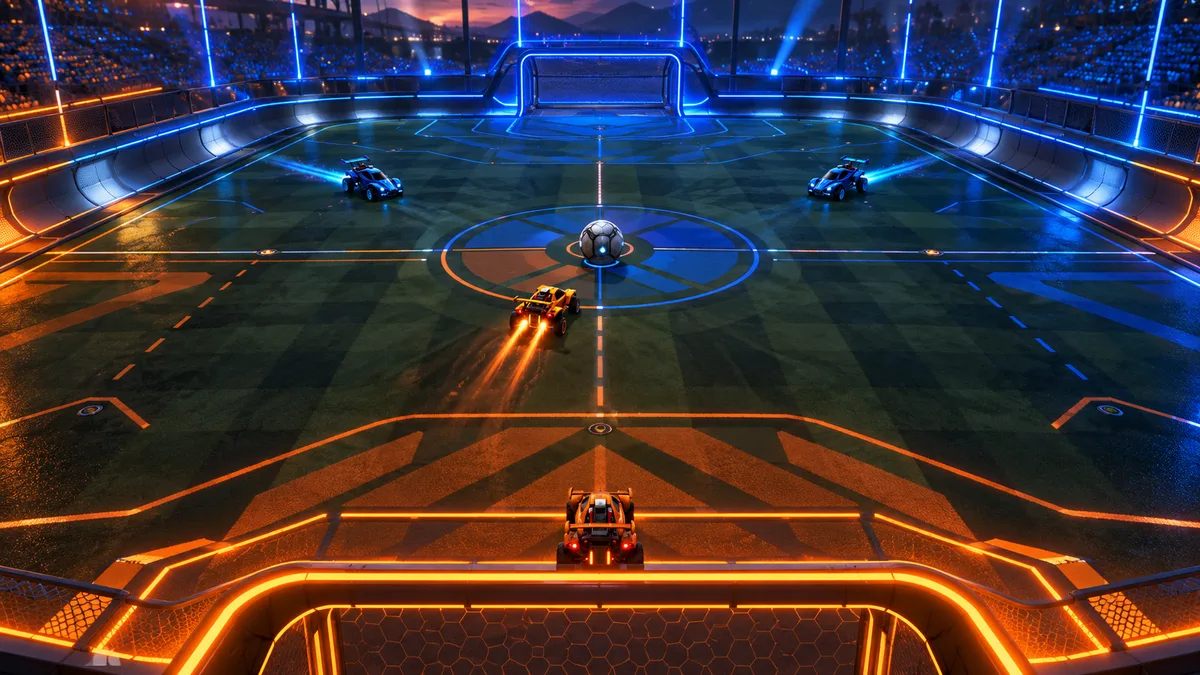
In 2v2, read the kickoff as two connected plays: the challenge at center and the first useful touch afterward. The second player has to choose how much ground to take without giving away the net. That choice depends on what both challengers actually do, not a prediction made from their spawn alone.
Give the first challenge to one car
Before the countdown ends, identify your team’s challenger. The closer player usually has the simpler route. If the choice is unclear, a quick chat call is more useful than both players guessing. Rocket League’s official beginner tips make the basic point: one player goes for the kickoff while a teammate covers.
Once your teammate takes the challenge, your job changes. You can move toward the loose ball, collect boost and defend, or hold a middle distance. All three are legitimate. What fails is entering the same central challenge late, because a lost 50/50 can pass both of you.
If your teammate does not move, the assignment changes. Challenge the ball or prepare for an immediate defensive touch. Do not continue a planned boost route while the center ball is uncontested.
Five reads before the second touch
These are five situations to check, not five kickoff types you can identify from a spawn point. Look at movement first, then revise your read when the ball is struck.
| What you see | Second-car response | Risk to respect |
|---|---|---|
| Your teammate clearly commits to center | Choose a controlled cheat or a deeper boost route | A hard loss can travel directly toward your goal |
| Both teammates head for center | Yield if you can still turn out; cover the result | A second challenge leaves nobody behind the ball |
| An opponent’s second car follows close behind their challenger | Be ready to contest the loose ball or protect the lane home | Racing them blindly can turn one lost touch into an open net |
| An opponent’s second car stays deep or takes boost | Expect them to have space after a long clear | A soft touch into their half may simply hand them possession |
| An opposing challenger slows, turns away, or does not contest | Treat a fake as possible and watch your teammate’s touch | An uncontested hit can still be sent straight to the waiting opponent |
The table is a starting position, not a script. The ball’s exit direction takes priority once the cars meet. A cheat that looked sensible before contact becomes a retreat if the ball shoots toward your net.
Cheat, hold, or take boost?
Cheat up when your teammate is contesting and you can reach a likely short rebound without abandoning the route home. Stay far enough back to react to a clean loss. The closer you follow, the quicker you can claim a dead ball, but the less time you have to defend a ball that escapes behind you.
Hold a middle distance when the opponent’s follow-up is unclear or your teammate’s contact is inconsistent. You give up some immediate pressure for a better view of the ball’s direction. Turn toward the developing play rather than driving at the center spot on habit.
Take boost and cover when you need a safer defensive start or expect a long ball. The full boost pickup has a cost: you may arrive too late for a short neutral ball. Check the ball and the opponent’s second car before committing to the corner.
Our kickoff cheat timing guide goes deeper on the tradeoff between moving up and keeping coverage. Use it as a companion, then test the distance against your own replays.
The first touch is information
At contact, stop evaluating who got there first. Watch where the ball exits and which player can reach it with control.
- Ball stops near center: A nearby second car can challenge or collect it, provided they have not driven past the play.
- Ball rolls or flies toward your half: Defend the lane to goal. If your teammate is still recovering, you are the last car for the moment.
- Ball goes into the opponent’s half: Check their second car before charging after it. A ball in their half is not automatically your possession.
- Ball kicks toward a side wall: Read the bounce and the opponent’s angle. A touch off the wall can create a better challenge than a straight sprint through midfield.
The kickoff challenge is still a 50/50 decision. Contact angle and follow-up matter. A clean win, a dead ball, and a hard loss demand different responses from the same starting position.
Second car: do
- Confirm who is challenging before moving
- Track the opposing second car
- Keep a route back while cheating
- Change plan when the ball exits the contest
Second car: don't
- Join the same center challenge by default
- Assume a speed flip guarantees a favorable touch
- Call an opponent's plan from spawn alone
- Chase a ball that already has an opponent waiting under it
Review a lost kickoff without guessing
Save a replay with a kickoff that led to pressure against your team. Pause before the cars move, at first contact, and at the next controlled touch.
- Before movement: Who was assigned to challenge? Did both teammates make the same call?
- At contact: Where was the second player on each team? Could your second player still defend a hard loss?
- At the next touch: Who controlled the ball, and what route gave them that touch?
If both teammates challenged, work on role assignment and read the double-commit breakdown. If your first car missed or sent the ball directly to an opponent, practice that contact. If the second car reached the right area but rushed the bounce, practice waiting for the actual exit. The replay should tell you which problem occurred; the scoreline cannot.
In solo queue, you cannot control your teammate’s choice. You can still read their first move, signal your own intent, and take a route that covers the play they are making. For more on spotting a teammate’s habits early, see reading your teammate.
FAQ
Should the second car always cheat up in 2v2?
No. Cheating gives you a chance at a short neutral ball, but it also leaves less depth if the ball comes straight toward your goal. Choose a distance you can recover from and adjust when you see the first touch.
Can I tell a speed flip or fake from the spawn position?
No. Spawn shows where a player starts, not what they intend. Watch the first movement and stay ready for either a contest or a fake.
What if both teammates are equally close to the ball?
Make the assignment clear before the countdown ends. A quick chat call can help. If neither player calls it, watch your teammate's first movement and avoid driving in as a second challenger.
Is a lost kickoff always the second player's fault?
No. An uncontested ball, a weak first touch, a missed follow-up, or a risky cheat can each give up possession. Replay the whole sequence before deciding what to practice.